
Jo Chipchase, an urban and rural driver, explains the controversy surrounding the V16 baliza (beacon) – the warning light that some motorists love to hate., and has been introduced like an elephant in the room…
MOTORISTS in Spain are under increasing control, with Guardia Civil patrols around many ‘corners’, low emission zones (ZBEs) that roughly 80% of current vehicles cannot enter, and rules that change at the drop of a hat. Coming straight from Temu (joke), the V16 baliza was sold as a safety upgrade: fewer roadside deaths placing triangles on hard shoulders, less risk for motorists, and it can send your location straight to the DGT 3.0 system and apps such as Waze and Google Maps (if you use them).
From 1 January 2026, drivers have been required to carry the V16 beacon in their car. It is a flashing, amber device intended to keep motorists inside their vehicles while alerting official services of the breakdown locations. In theory, it could be modern and sensible. Theory versus reality is the issue here!
Sadly, the implementation of the new device has not been smooth or coherent – rather like the dog law that was shelved at the last minute (for being unenforceable) and ‘Solo Si es Si’ – a law regarding sex offenders that accidentally saw sentences reduced for the likes of the Wolf Pack, and had to be reworked.

From safety device to theft magnet
The background to the V16 baliza is serious and sound. It is, arguably, the implementation that went wrong. Between 2018 and 2022, more than 100 people were killed on Spanish roads after leaving their vehicles, while placing warning triangles to alert other drivers of their breakdown. The baliza was meant to prevent this problem (allegedly).
The first unintended consequence arrived quickly. Across Spain — especially in Granada region — police have reported a sharp rise in thefts from vehicle interiors, with the V16 baliza a main target. It is small, easy to sell, worth €40–€50 (despite probably costing 2e to make), and frequently left visible in cars. In Granada city alone, over 100 break-ins were recorded in a single month, prompting special patrols and arrests. Reports consistently describe repeat offenders, and junkies, operating at night in low-footfall areas. For rural towns such as Órgiva, with a long history of car break-ins, that is exactly what vehicle owners welcome… ahem!
While many people welcome new safety devices, some motorists arguably view the V16 beacon with suspicion. Planning wise, it is as well-conceived as the incoming law to lower the drink drive limit, meaning that men can have a beer while women have to throw half into the nearest bush to avoid a ‘multa’. This is another problematic plan that will end up looking “machista”. The limit should be 0.0% to not penalise one gender.
Storm Leonardo and the V16 beacon limits of visibility
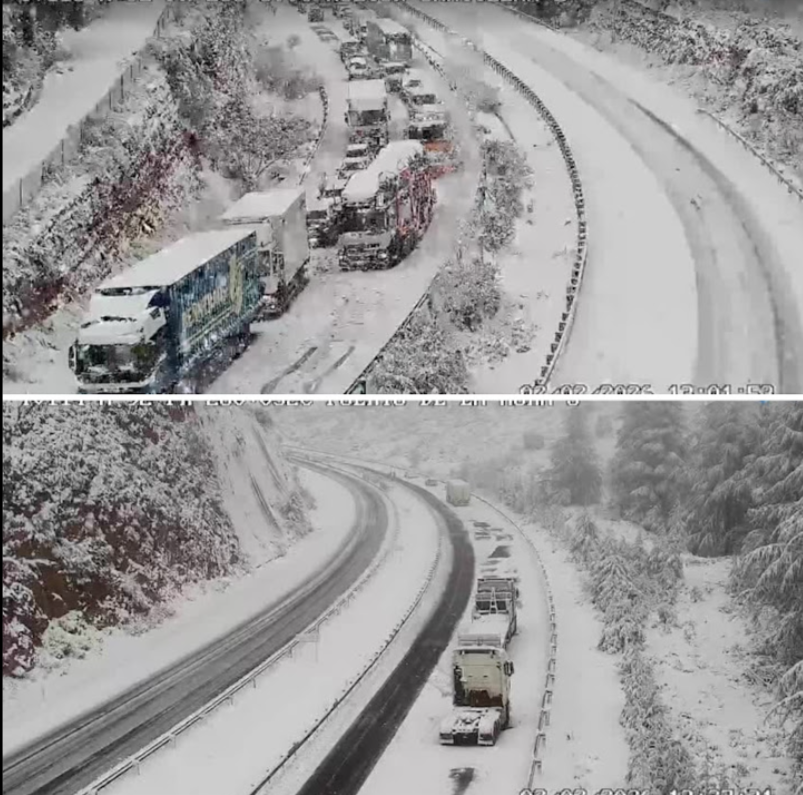
Recent extreme weather events in Andalucia highlight a simple issue: visibility of the V16 beacon is not guaranteed. During Storm Leonardo – with torrential rain, fog, wind, and floods – a small beacon on the car roof might not be your obvious rescue plan… especially with cars floating in rivers that have burst their banks! Can we geo locate it? No, it is floating downstream! Recent news coverage showed vehicles stranded on roads with near-zero visibility, cars with snow covering the roof, and water rising rapidly around vehicles in riverbeds. Notably, the images rarely show a V16 baliza in place. In a situation of being submerged, perhaps the V16 beacon would not be your first thought!
In heavy rain and fog, a small, amber light offers limited benefit when car headlights disappear out of sight. In mountain areas, low cloud and fog can reduce visibility to almost zero. These are conditions in which the V16 baliza is unhelpful.
The public V16 baliza map that really does exist
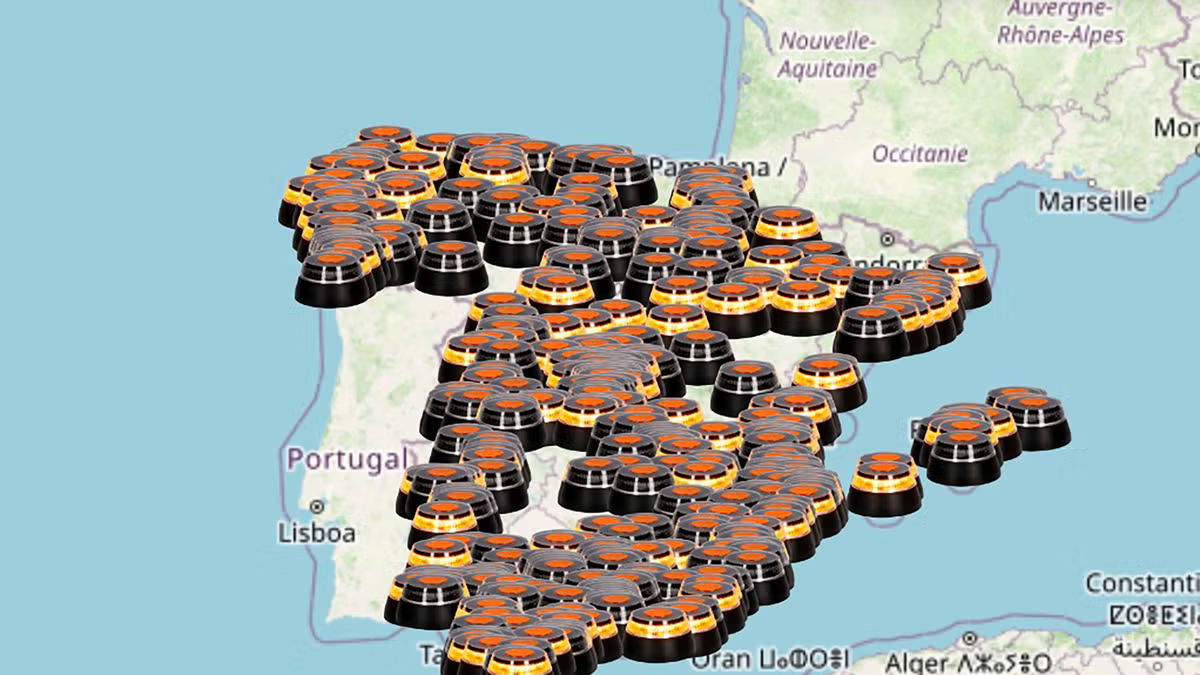
No, it is not fake news! What pushes the V16 baliza from an overpriced device with a poor public launch into something more troubling is the live, public map of activated V16 balizas in Spain.
This very real project was created by Héctor Julián, an engineering student who discovered that the data stream feeding the DGT 3.0 system was publicly accessible. He built a real-time map showing where V16 balizas are active, with timestamps and precise locations. The existence of the map was reported by 20 Minutos and shown on national television.
In practical terms, when a V16 baliza is activated, a vehicle that has broken down or had an accident can be located online by anyone who knows where to look. Authorities insist that the system is safe, while insurers are simultaneously warning drivers about “grúas pirata” — fake or unauthorised recovery vehicles turning up uninvited. Those two messages are contradictions.
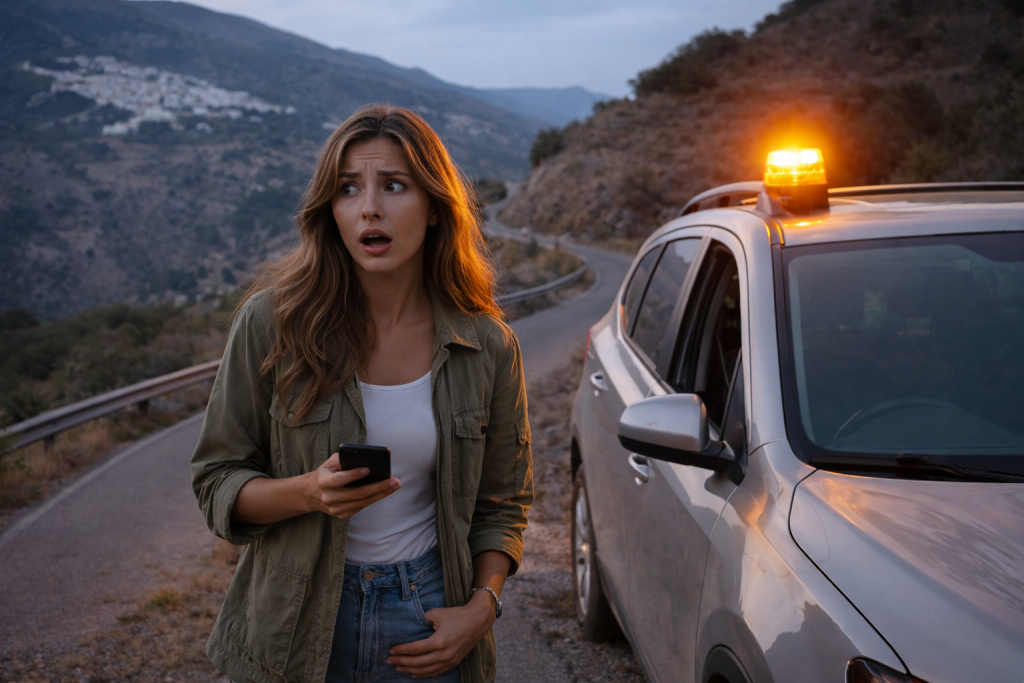
Just for an example, a woman driving alone in a remote area might not want their location broadcast – especially with valuables in the car and the knowledge that you can’t start the vehicle and escape. What was wrong with privately calling the ‘grua’?
“You’re a conspiracy theorist”
When the repoter raised this concern, a gasolinera worker dismissed it with you are “una conspiranoica.” Not really. As a solo female driver generally circulating in remote locations, it is a vulnerability. We cannot compare breaking down outside your local gasolinera to being stuck on a rural track with nobody around.
In these situations, it is more reassuring to call roadside assistance privately.
If someone turns up unexpectedly, they could be a bad actor. They know that you’re stationary and cannot leave. Even if the car’s contents amount to nothing more than bales of hay or dog food – not the latest iPhone – there is an element of doubt. Do ‘gruas’ carry ID cards? Rather like the ‘rogue’ gas installation scamsters who charge ‘newbies’ in the area 200e to change an orange tube costing under 10e, you must be assured that a person is who they claim to be.
This isn’t paranoia. It’s basic risk assessment. Even if nothing has happened yet, it could do. And If it does, there will be a scandal.
The mechanic who said “don’t buy one”
With uptake of the V16 baliza by no means universal, one sceptical voice came from a local mechanic — someone who regularly repairs rural vehicles. His advice was unequivocal: don’t buy a baliza. Anyone can see where you are stuck!
On top of that, we have rural roads with hairpin bends (you cannot see a light round that!) and frequent low clouds. Could the ALSA bus or a lorry hit your car? Is this safer than placing a triangle before the bend? It’s arguably a matter of time before mangled cars have to be replaced by disgruntled insurance companies. And why? Because other motorists could NOT see the light on some slip road and could, perhaps, drive straight into the disabled vehicle at speed. Perhaps the authorities will then commision a “study” – then there could be a corruption case – like Koldo re Covid masks.
OK, so triangles aren’t perfect but the V16 baliza introduces new dangers without accounting for terrain, weather conditions, bends in the road, other drivers looking at their Spotify playlist or whatever, rather than the hard shoulder. So, now the advice is to use the triangle and V16 baliza together. But aren’t the triangles supposed to be life-threatening? Another contradiction.
Multas, mixed messages, and non-compliant devices
Officially, failing to carry a V16 baliza can result in a fine of around €80, lowered to 40e if paid quickly (the same price as the device!). The Guardia Civil has promised flexible enforcement during the transition. Adoption is widespread but not universal; officials have spoken of thousands of activations per day since January. However, the reporter encountered a man with a confused expression saying “baliza – what is that?”.
Confusion deepened when, just as the rule came into force, the DGT removed four V16 baliza models from its homologation list after their certification expired and was not renewed. The affected devices — Don Feliz V16IoT, The Boutique For Your Car V16IoT, Ikrea V16IoT and Call SOS XL-HZ-001-VC — had been sold as compliant until that point. Owners were later told they could continue using them, but the timing did little to inspire confidence.
Follow the money (carefully)
As is frequently the case, there are mutterings about who benefits from providing a mandatory device. One of the most visible V16 baliza brands expanded rapidly with institutional backing and public-sector contracts, prompting questions about compulsory technology and guaranteed markets. Sounds familiar?
There is no evidence to show that the V16 baliza rule was engineered to favour a particular company, but in Spain, mandatory tech plus government procurement can breed suspicion. Clearer communications and a proper public information campaign would have been a good plan from the start!

What happens next?
OK, so everyone has their own opinion on this topic. While some motorists hail improvements to “road safety”, many others remain sceptical. The V16 baliza was launched to “reduce roadside deaths”, while ignoring the fact that it increases the chance of a rear-end shunt from a passing lorry in a poor visibility scenario. It has also created new vulnerabilities – whether this is atmospheric conditions, the public-facing map, or that your battery has died – or the entire device has failed because it is a cheap piece of plastic.
For now, the advice is: don’t leave the V16 baliza visible when you park, be sceptical of unsolicited roadside help, and trust your instincts when something feels wrong.
A safety system that reduces one risk while amplifying others deserves scrutiny — not because it is a bad concept, but because it was badly launched.