
Jo Chipchase examines the latest V16 baliza controversy… a bumpy road lies ahead, but will there be a U-turn…?
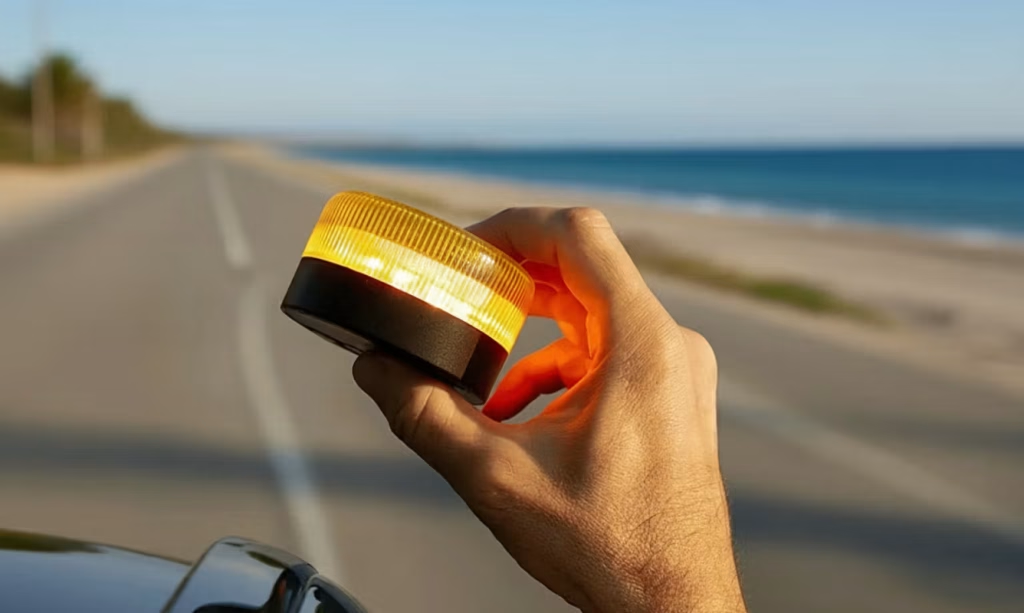
SPAIN’S compulsory V16 baliza – the flashing rooftop light for “road safety”, resembling a cheap torch from TEMU – is no longer just a vague controversy (‘una polemica’ in Spanish). As predicted by South of Granada, it is now becoming a legal issue. The European Commission (EC) has confirmed that Spain introduced the V16 baliza without following the EU’s required notification procedures,
In EU terms, that is not just an oversight. It centres on whether the rule complies with single-market law, and whether it can be enforced in a member state.
Thus far, public debate has focused on whether the V16 baliza is a “good idea” for road safety – rather than whether Spain was entitled to impose it in the first place. Under EU law, this is a looming problem. And the outcome could prove… interesting. A roadblock?
Why Brussels is questioning the V16 baliza
Directive (EU) 2015/1535 requires that member EU states notify the EC if they intend to adopt a draft, technical regulation that could affect the internal market. The idea is to stop national rules from creating trade barriers or fragmented technical standards, under the cover of safety or consumer protection. Yes, this is technical jargon! In simple terms: was it legal?
In February 2026, the EC stated, in a written reply in the European Parliament, that Spain’s V16 baliza obligation for motorists was not notified under this formal procedure. This can have consequences for Spain. The EC Court of Justice states that technical regulations, which should have been notified correctly, but were not, can be treated as legally inapplicable against individuals. That means, in simple terms. not forcing you to have a V16 baliza in your car!
In plain English, a rule can exist in Spanish law and still be on dubious legal ground – if it was introduced incorrectly at EU level.

A Spain-only solution in a single market
The problem is not just that Spain enforced the V16 baliza as a warning beacon. As we know, Spain has mandated a specific type of device – a connected V16 baliza, on the DGT “approved list”, and integrated into Spain’s DGT 3.0 traffic platform.
There is no EU-wide standard for such devices. Other member states do not require them. Cars have their own hazard warning lights, applied universally by manufacturers. Furthermore, the EU doesn’t see the V16 baliza as a substitute for warning triangles. Foreign vehicles driving in Spain are exempt from the rule. Spanish drivers travelling abroad must still carry triangles… not a flashing beacon to ‘augment’ the inbuilt hazard lights that are universally used.
The situation sits oddly in a single market designed to avoid such decrees. Under EU law, Spain may impose a technical requirement, but only if it is deemed necessary, proportionate, and properly justified. That legal burden is high, and it is now being tested by “those above”. Will it fail? Probably!
The effectiveness of the V16 baliza and the legal situation
The legal vulnerability of the V16 baliza is driven by uncertainty about its real-world performance. Spain’s rationale is straightforward: drivers should not have to step into traffic (like on to the hazardous hard shoulder) to place warning triangles near their car. Presumably, they might be mowed down by a passing vehicle. Reducing that risk is a legitimate objective.
The debate regards the (untested) assumption that the V16 baliza is automatically safer than other safety measures – in all conditions.
A roof-mounted V16 baliza relies on the batteries working, some lighting contrast, and road geometry. Allegedly, in strong daylight, a small, amber V16 beacon can be lost against the background (as any photographer will know!). Allegedly, on blind bends, road crests, or winding passes, it may not be sufficiently visible to provide a meaningful warning to other cars. Allegedly, in fog, glare, or heavy rain, its effectiveness may decline – when visibility matters most.
Critical voices
These are not claims of proven failure. They are plausible scenarios, grounded in optics and road design. They have been raised – repeatedly – by authorities, as well as motorists. To add to the ‘polemica’, the location of broken-down vehicles appear on a public map, which no solo driver desires!
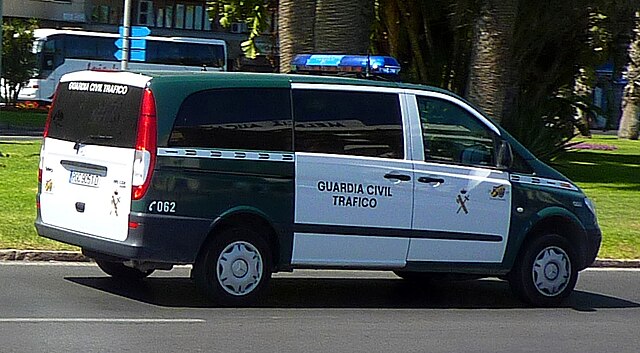
The Guardia Civil’s professional union, Jucil, speaking through its spokesperson, María Cívico, publicly warned that the V16 baliza “does not guarantee anticipation in all scenarios” and can be difficult to see on winding roads, particularly where there is no direct line of sight. Hardly a surprise!
Traffic officers and emergency professionals have voiced concern about the visibility of the V16 baliza in certain conditions. The Asociación Unificada de Guardias Civiles (AUGC), which represents traffic officers who attend roadside incidents, has warned that in areas with curves or limited visibility, the V16 baliza “simply is not seen in time to avoid an accident”.
OK, so nothing here categorically proves that the device is dangerous. It does, however, underline that the effectiveness of a rooftop V16 baliza over the traditional warning triangle is not proven in all scenarios.
And that distinction matters in EU law. A national measure of this kind must be supported by demonstrable safety benefits, not just theory.
Alleged scenarios re the V16 baliza
There is, at present, no officially documented case in which a roadside collision has been attributed to the use of a V16 baliza instead of a triangle. No Guardia Civil report, court ruling, or insurer analysis has established that causal link that seems so…. obvious.
However, that absence cuts both ways. It means that the V16 baliza isn’t (currently) proven to cause accidents. It also means that it isn’t proven to prevent them either.
What does exist are illustrative, alleged scenarios – widely discussed and circulated – in which the V16 baliza allegedly isn’t visible in certain roadside conditions. These examples are currently warnings, not evidence.
Uncertainty, however, is exactly what weakens a compulsory rule that the EU is examining.
The absurdity test for V16 balizas
There’s a simple way to illustrate the problem. If visibility is the main safety concern, in some conditions, placing reflective objects further down the road would, allegedly, provide an earlier warning sign than a small light perched on your vehicle roof.
One amusing report involved motorists deploying 2ltr bottles of Fanta Orange to warn about a breakdown. No one is suggesting using bottles of fizzy drink as safety equipment. The point is that a better warning might result from those large bottles than a tiny light. Strangely, the news story about this incident is currently difficult to locate, although the reporter saw it in person.
The social media comments were priceless – which is possibly why the post has been (potentially) removed!
From recommendation to obligation, without proper testing
Much of this controversy could have been avoided. Spain could have promoted the V16 baliza as a supplementary device to the triangle. Instead, it tried to abolished triangles and make the V16 baliza the only legal option.
That decision magnified every weakness. A compulsory replacement must be defensible – in court, in Brussels, and on the road.
Public uptake has been variable. The reporter knows motorists who bought a V16 baliza, then left it, with unbroken plastic seals, in their glovebox. Is that even legal – or safe? It is hardly going to alert an incident to the DGT 3.0 system.
How is the V16 baliza scenario likely to end?
This burning question is up for debate!
The EU rarely has reversals. Frequently, it applies pressure until a member state adjusts its behaviour. Spain may allegedly be obliged to downgrade the V16 baliza from mandatory to recommended. South of Granada considers it unlikely that the current, compulsory model will survive beyond 2026. Perhaps, down the road, there will be a Koldo-like case – like with Covid masks – examining “who got the money”.
That was, arguably, obvious from the start.
The real cost to motorists… and to Spain
Beyond the legal arguments lies the issue of credibility. Rather like low emission zones (ZBEs), that ban around 80% of cars in Andalucia from entering city centres, it is not well-conceived.
Road policy depends on trust. When drivers are compelled to buy equipment that is legally contested, operationally questioned, or simply looks like it cost 2e on TEMU, compliance becomes questionable. Just like people wearing Covid masks in the middle of nowhere, then throwing them on to bar tables, it is “un desastre” – and a PR fail requiring damage limitation tactics.
The V16 baliza was meant to signal danger to other motorists. Instead, it has shown another hazard — what happens when greed and poor decisions overtake common sense. And this story is far from over…. so watch this space!