
Jo Chipchase explains the proposal to lower the drink drive limit in Spain – rejected by parliament – and why this was unlikely to work in rural Granada….
AFTER several months of debate in parliament, plans to lower the drink drive limit in Spain from 0.5 g/l to 0.2 g/l in blood (0.25mg/L and 0.10mg/L in breath) have been thrown out. This would have meant close to zero tolerance. But not quite! The proposal, introduced by the government and promoted by road safety authorities – including the Dirección General de Tráfico (DGT) – was mooted in late 2025, and recently failed to secure a majority in parliament.
The proposal to lower the drink drive limit in Spain was blocked by an unlikely alignment of opposition parties, including the Partido Popular, Vox and ERC, following a closely contested vote.
Few would argue in favour of drink-driving. That was not the point. The question was whether the proposed change to the drink drive limit in Spain truly addressed road safety (‘seguridad vial‘) – or risked damaging the economy (i.e. the hospitality sector). There’s also the concept of appearing a ‘tad sexist’ – in a country that wants to appear progressive re gender equality. “Economic and social” reasons were the counter-arguments.
Read on for more of the real issues….
Altering the drink drive limit Spain: a ‘can of worms’
If the proposal for a lower drive limit in Spain had passed through parliament, motorists (already suffering from the V16 lights and ZBEs) would face a single alcoholic drink placing them over the limit. Especially women.
In urban areas, this is manageable. You call an Uber or taxi in both directions. In rural Granada, however, it is more problematic – a simple question of mobility and infrastructure (or lack of!). And an absence of taxis, Ubers, and buses.
On top of tackling Andalucian habits, ingrained over decades, there are practical considerations to slashing the drink drive limit in Spain. You rarely see a taxi rank in a mountain village – nor a late-night bus to the next town. Even if there is a a tax, will it go up your rough forestry track? Driving is not optional – it’s the only way to reach the nearest settlement. Unless you want to walk 10km in your fiesta dress!
Of course, choosing non-alcoholic drinks while motoring is the safest option. That is very clear. However, the reporter already heard an old-timer bemoaning: “You can’t even have a ‘cubata’ at the ‘feria’ these days! There are three vans of ‘traficos’ on the roundabout!” He went home (wisely).
Examining reality versus the desired scenario of abstinence, the ‘cerveza’ culture is deeply ingrained in rural Andalucia. It is not based on people getting horribly drunk (like Brits in Magaluf, falling over, jumping off balconies, and requiring ambulances!). It is workers, old guys, and couples (or singles) enjoying a couple of fresh beers with their food. If one beer can be too much, there can be confusion over the prevailing drink drive limit in Spain, and what is acceptable.
With recent talk of the “manosphere”, we have the valid point of gender roles when considering the drink drive limit in Spain. Women, on average, metabolise alcohol differently to men because of their body composition and liver enzyme levels. This means that the same drink can cause a higher blood alcohol concentration in women than men.
In practical terms, a lower drink drive limit in Spain of 0.10 mg/l in breath (about half a beer for women and one for men) could easily throw the designated driver role back on to the wives. I bet they appreciate that! Or they can quietly throw half their ‘cerveza’ into the nearest bush or plant pot while the men guzzle the whole glass.
The policy is meant to be gender-neutral. But, in a country that places strong emphasis on gender equality (at least on paper), how such measures play out in everyday, rural, life is up for debate.
South of Granada believes there are two sensible positions: maintain the current drink drive limit in Spain, or implement 0.0% for everyone.
However, a drink drive limit in Spain of 0.0% would surely warrant a public information campaign about how long it takes to metabolise each unit of alcohol, according to your gender and body weight. Maybe non-alcohol bars, not just serving fizzy drinks that are sugary, would be a great plan! The UK is more developed in terms of non-alcoholic options, that are not associated with children, or sickly!
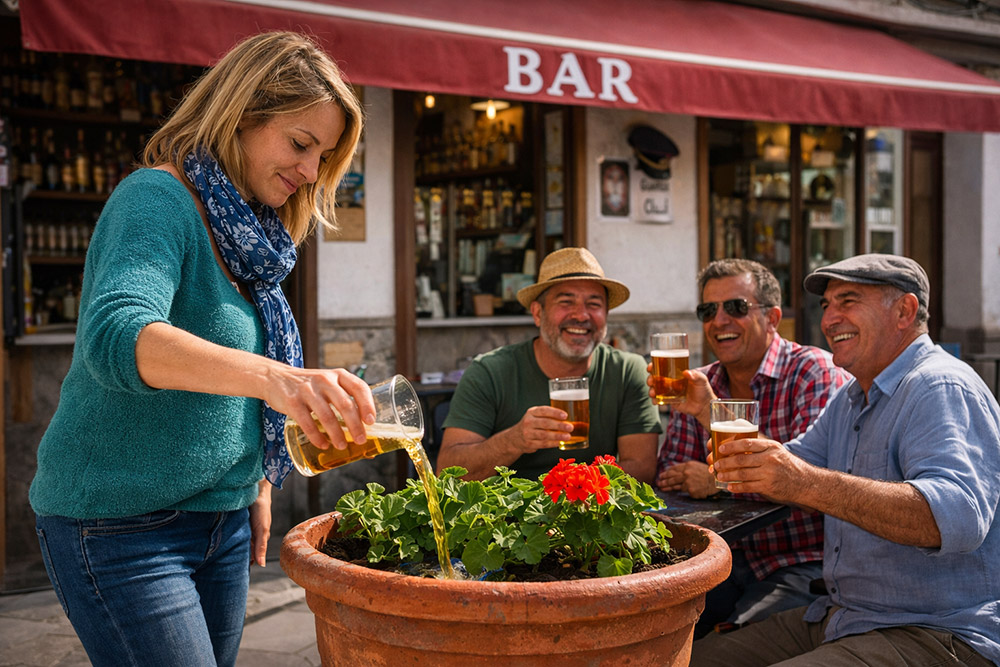
One cold beer, not falling over drunk
It is arguable that Spanish people can hold their drink, and are not out to get “pissed”. Go to tourist villages “off the beaten track”, and a pattern emerges. After a hike along a marked path, or exploring a quaint village (possibly in the heat), people tend to stop for a drink. One local bar proprietor suggested – informally – that around 90% of male customers choose beer and definitely don’t want tea or water, like ‘las mujeres’.
Not several beers! Not getting “smashed”, stumbling around and falling over! Just a couple of cool ‘cervezas’ after navigating those rocky patches and foliage on the hiking path.
Lowering the drink drive limit in Spain would not necessarily remove that behaviour. It would redirect it. If men are culturally resistant to that nice glass of “agua” after a hike in the ‘campo’, perhaps the next village might seem a less desirable choice for a day trip. Especially if it is a group of men together, and not a family with kids. You have worked hard all week – mixing cement, strimming borders, or fixing cars. It is a question of changing attitudes before implementing a confusing change to the drink drive limit in Spain.
There are many out-of-town venues that rely on groups of visitors to survive. It is a logistical problem! Unless attitudes and culture change (through public information campaigns), these venues are likely to suffer from slashing the drink drive limit in Spain. Imagine a communion dinner or wedding party – with bottles of water as the main choice. If people fear a ‘multa’ after consuming half a ‘cerveza’, will bookings fall? Maybe they will just hire a ‘cortijo’. Yes, we have ‘sin alcohol’ beer – but the real stalwarts will (rather daftly) insist that it “tastes wrong” or is full of “dead calories”. Furthermore, what happens to the regional breweries who rely on selling their “real” beers to venues, including those based outside towns?
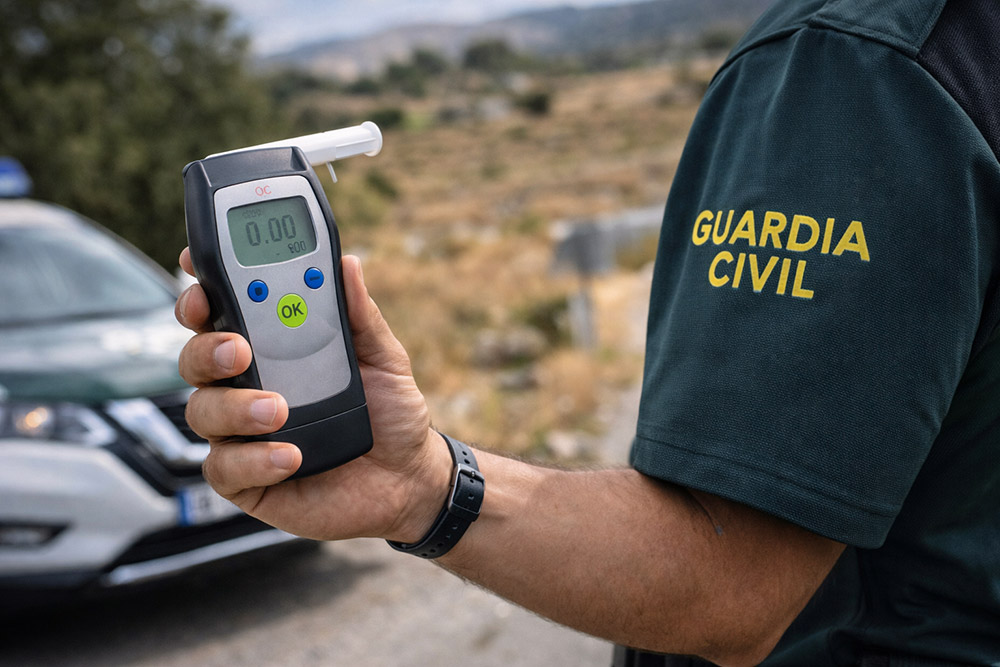
Changing culture before laws re the drink drive limit in Spain
As with domestic violence and animal abuse laws in Spain, there is a need to educate people and change social attitudes before going full force with legislation. Some laws creep in without much fanfare – and will later be revoked when they go wrong (the V16 ‘baliza’ is a probable candidate here!).
In many rural settings, old guys still tie dogs on chains and drown puppies. Are they going to listen about not drinking beer at the fiesta in the next village? Perhaps, emphasising the health benefits would be a good start before insisting on changing the drink drive limit in Spain.
Things do change. Gen Z is drinking less. They have seen their elders guzzling toxins and desire a healthier life. And they are right.
Even so, a stricter drink drive limit in Spain might simply shift the die-hards towards private gatherings, such as ‘cortijo’ parties (alway popular) – especially with the cost of fuel at present. Even better: when you’ve had too many ‘cervezas’, you can just go to bed! And Gen Z will hang out in the local carpark, chatting and playing tunes!
Spain is already seeing the cost of living rise again. The impact will likely be felt in the hospitality sector: usually the first to suffer when people tighten their purse strings.
Fiestas, fines, and living in reality
The same logic applies to event management. When people have less money, they reduce going out. A town fiesta generally relies on drawing visitors from a wider catchment area – not just its own residents. These people spend money in the on-site bars. This won’t work so well when one beer at the municipal ‘carpa’ lands you a 500e fine and six points on your license. These are ordinary, low-key, social situations – not Ibiza at 11am in high season (although that is apparently being more controlled now!). Oh, just stay at home!
The likely outcome of such a heavy tweak to the drink drive limit in Spain is avoidance. Fewer people staying at events. Leaving early to watch Netflix in bed.
Water, soft drinks, and alcohol-free options remain the safest choice for any driver. But these aren’t well-developed markets in Spain – and why would you go to the next village, only to watch other people down the “cerveza gratis” – that appears at times – or sup from the “fountain of vino”.
We wonder if this was debated in parliament!
Alcohol vs drugs: two legal models
The debate about the drink drive limit in Spain exposes an inconsistency – involving “demerit goods” (toxins) that are and aren’t taxed. Alcohol is regulated through actual limits. You can be a drinker and remain within the law. You could be a serious binge drinker, with brain fog, “hangxiety”, and the shakes, but pass a roadside test the next day by abstaining for sufficient hours. This, arguably, isn’t the best mode for road safety!
Drugs are treated differently. Under rules enforced by the DGT, any detectable presence of an illegal substance can lead to a sanction, regardless of impairment at the time of driving. Yes, that means the “waccy baccy” smoked a week ago!
Supporters argue that this is a clear and enforceable law. Critics question whether the driver is impaired – and does that matter? This could be a whole debate on its own.
To some people, this is an an area where the law could allegedly appear uneven-handed. One system measures impairment with defined, limits. The other bypasses it entirely. So, we could effectively castigate a motorist who is – arguably – driving more proficiently than a shaky person with an Alcohol Use Disorder and a vast part of their grey matter destroyed over years!
The DGT is promoting a seminar about this on 28 April.
Why enforcement feels constant in rural Granada
In rural Granada, DGT Trafico enforcement is not theoretical – it is visible around every corner (or roundabout), where roads converge. Also supermarkets, gas stations, electricity substations….
Roadside controls by the Guardia Civil are a regular feature on key routes such as the A-348 (Alpujarra to Almeria) and the junctions around the Rules dam and Béznar, which serve as access points to the A-44 – the Autovía Sierra Nevada–Costa Tropical – linking Granada with the Costa Tropical.
To a resident, it can allegedly feel like targeting! Is this a function of geography? These are funnel routes. Everyone passes through them. Strategic. A checkpoint can capture a large share of traffic – especially after a feria or when lunchtime ends on a public holiday!
The visibility of controls is reinforced by the scale of enforcement. In 2024, more than six million roadside alcohol and drug tests were carried out across Spain by the DGT. During a typical national campaign week, well over 200,000 drivers are checked, with several thousand testing positive. Crucially, the vast majority of captures are by roadside controls – not because someone is driving badly.
Compare that with inland Málaga, where traffic disperses across multiple roads, and enforcement feels lighter. Or the UK, where you hardly see a roadside patrol.
The strategy is a whole debate in itself.

The drink drive limit in Spain: perception vs reality
There is no publicly available breakdown of roadside controls by municipality in Spain. However, enforcement is proactive, checkpoint-based, and intensified during national campaigns. As a general rule, if you plan to circulate, stick to the ‘agua’!
The current drink drive limit Spain works because it is understood, socially embedded, and realistically applied. If you start changing it, the public should be informed of the new rules well in advance.
There is also a case for a 0.0% limit. With this, there needs to be proper information:
- How long alcohol takes to leave the system.
- Why a late-night ‘cubata’ still matters the next morning.
- Why “I slept it off” is not always accurate.
- How sleeping in the front seat of your car, with the key in the ignition, could still land you in trouble!
The bottom line re the drink drive limit in Spain
For now, the idea of changing the drink drive limit in Spain has been rejected, and the existing one remains in place – 0.25mg/L in breath for non-professional drivers. Be aware: enforcement is visible, consistent, and unlikely to ease – particularly on main routes through rural Granada. People are gradually realising that they cannot drink drive: that they must find a designated driver or stay at home.
As with many laws in Spain, incoming ones sometimes fail. The dog welfare law is a case in point. ”Solo si es Si’ had to be rewritten, the V16 ‘balizas’ are having “issues” and the ZBEs are questionable in their approach (watch this space). We see these concepts appear, and know that certain ones are unworkable. Some come from good intention, some to make money, and others allegedly needed a SWOT analysis before unleashing them on to the public!
Meanwhile, drive safely and opt for the ‘agua’!