
Jo Chipchase examines Spain’s revived near-zero drink-drive proposal, the evidence behind it, and why rural hospitality could be hit the hardest...
MORE dubious news is afoot for Spain’s motorists. The Socialist parliamentary group (PSOE) has formally revived its proposal to tighten drink driving in Spain, registering a new bill in Congress on 11 September. If approved, the general limit would fall to 0.2g/L of alcohol in blood and 0.10mg/L in breath. This is low enough that even one beer or glass of wine could put some drivers close to, or over, the limit.
The new proposal recreates – more or less – the substance of the previous initiative that appeared in Spain’s Congress during March 2026. It would reduce the maximum drink drive limit in Spain from 0.5g/L of alcohol in blood to 0.2g/L, and from 0.25mg/L to 0.10mg/L in breath. Although supporters describe the approach as ‘tolerancia cero‘ (zero tolerance), it is not technically a zero-alcohol limit. PSOE says the measure is intended as a preventive road-safety reform, rather than a revenue-raising exercise.
South of Granada examined drink driving in Spain earlier this year, when the proposal was unexpectedly defeated in Congress. Can it be pushed through on the second attempt? We’re not convinced.
The bill failed on just one vote previously
The previous attempt to reform drink driving in Spain was defeated in the Interior Commission, during March 2026, by 19 votes to 18. On this date, PP, Vox, ERC, and UPN voted against it. PSOE promised almost immediately that it would try again with the bill.
The defeat was not merely about the actual alcohol limit. PP objected to the way that the reform had been processed, while ERC’s opposition was connected to rejected amendments concerning traffic examiners in Cataluña. Vox argued that the measure was disproportionate and potentially ‘recaudatoria’, or revenue-raising. Unless at least one of the political parties changes its mind, the same outcome could happen again.
And, yes, we can’t ignore the idea of raising revenue amongst a pool of motorists who are already grappling with ZBEs and V16 beacons.
Drink driving in Spain: millions of alcohol tests
The revenue argument can be set against the scale of DGT and Guardia Civil traffic enforcement already taking place on Spanish roads.
According to the DGT’s 2024 road-safety figures, Guardia Civil traffic officers carried out 7,378,103 alcohol tests during that year – 10% more than in 2023. Almost 6.3 million were preventive tests, with around 1% producing readings above the existing limit.
The significance of lowering the alcohol limit becomes clearer from this summer’s campaign. Between 13 and 19 July, officers conducted 218,949 alcohol and drug tests. The DGT reported 2,259 alcohol positives, while another 4,233 drivers had consumed alcohol while remaining below the present legal limit.
Not all those motorists would have exceeded the proposed 0.10mg/L limit. The DGT has not published statistics showing how many fell between the proposed and existing limits. With millions of preventive tests each year, bringing a new group of motorists into legal sanction territory makes us ponder: how many additional fines would occur?
What are the proposed new alcohol fines?
The proposal creates a new €200 sanction for drivers whose alcohol reading is currently legal.
| Breath alcohol reading | Proposed fine | Licence points |
|---|---|---|
| Over 0.10 to 0.25mg/L | €200 | 2 |
| Over 0.25 to 0.50mg/L | €500 | 4 |
| Over 0.50mg/L | €1,000 | 6 |
| Reoffending within one year | €1,000 | 4 or 6 |
The previous Congressional text classified the new 0.10–0.25mg/L band as a serious offence carrying two points. Under Article 80 of Spain’s Traffic Law, serious offences carry a €200 fine, while the DGT sets out the existing €500 and €1,000 sanctions for the higher bands.
Does the lower limit target the problem?
The road safety case for tackling drink driving in Spain is difficult to dispute. Alcohol remains one of the principal risk factors in fatal accidents. A specific issue is whether drivers between 0.2 and 0.5g/L are sufficiently responsible for serious accidents to justify imposing sanctions.
That is the exact evidence that Spain’s hospitality industry wants to see. Hostelería de España, representing more than 300,000 establishments, has asked the DGT for accident statistics involving drivers between 0.1 and 0.25mg/L. Evidence that heavily intoxicated drivers cause fatal accidents establishes the danger of drink-driving, but doesn’t show how road safety would be improved by penalising drivers who are currently below the legal limit.
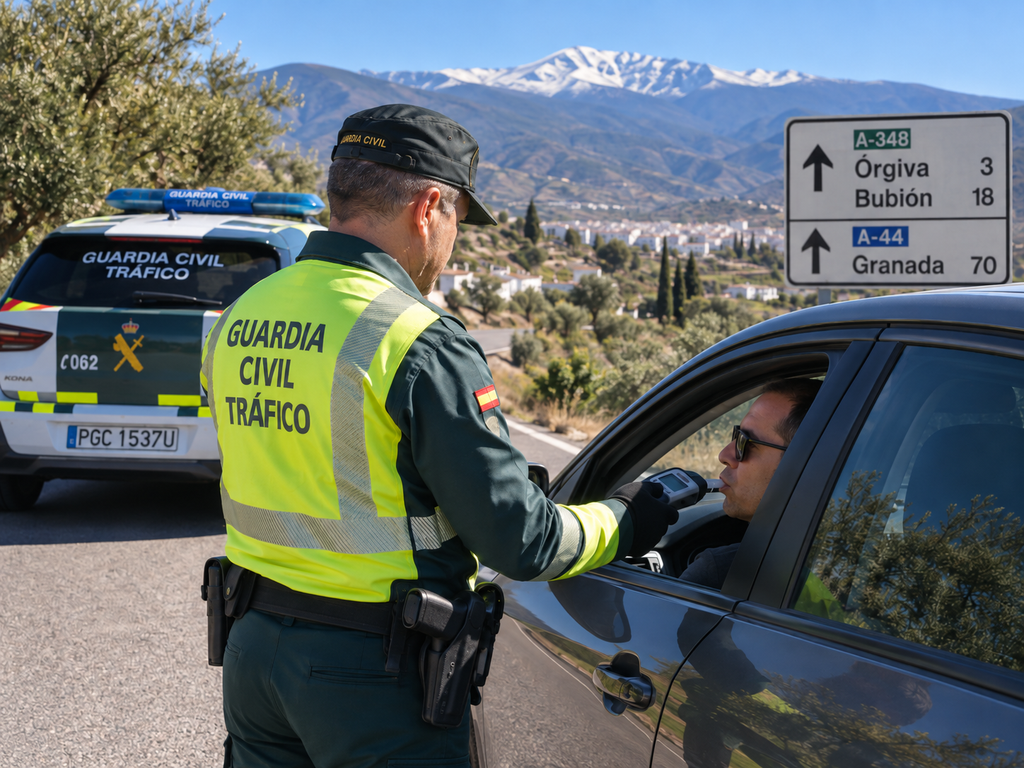
Drink driving in Spain. Image: ChatGPT
Alcohol is not the only concern
Spain’s drug driving regime is also controversial. The DGT’s sanctions information states that the administrative offence is driving with the “presence of drugs” in the body, punishable by €1,000 and six points. This differs from the criminal offence, which requires driving “under the influence”.
The numbers are striking. According to the DGT’s 2024 figures, Guardia Civil officers conducted 122,938 drug tests in 2024 – up 21% from 101,927 in 2023. Of 96,716 tests classed as “preventive controls”, 49% were positive. During the DGT’s July 2026 campaign, 1,835 of 5,779 preliminary drug tests were positive. Drug testing is considerably more selective than routine alcohol testing, however, so these percentages are not a broader illustration of drug use among Spanish motorists.
Roadside screening uses saliva to detect recent consumption of drugs, with positive samples sent for laboratory tests. However, the administrative offence is based on detected presence in the human body, rather than a fixed impairment threshold comparable with alcohol.
Rural hospitality takes the hit

These roadside tests matter in rural Granada and La Alpujarra, where restaurants, ‘ventas’, rural hotels, and village fiestas draw customers from wide catchment areas. Public transport and taxis cannot replace private cars like they do in cities – such as Málaga, or Madrid. If they exist at all, they tend to retire at midnight, or be very expensive.
Anecdotally, some local residents increasingly avoid fiestas, restaurants, and events in other towns – unless somebody is prepared to remain completely sober and act as designated driver. With taxis scarce, and neighbouring villages kilometres apart, tighter alcohol limits combined with drug controls may reduce attendance of venues and events, rather than simply curb alcohol consumption.
The impact of the proposed alcohol limit also varies between individuals. Alcohol concentration depends partly on weight, body composition, and gender – meaning that the same drink can produce different readings in different people. Women, on average, can reach a higher blood-alcohol concentration from the same quantity of drink than men. The law would be identical for everybody. However, the lower limit could make a ‘cerveza’ marginal – especially for women.
Back to Congress
The government can argue, with considerable evidence behind it, that Spain still has a serious problem with alcohol and road deaths. However, it is unclear whether reducing the general limit from 0.5 to 0.2g/L is the most effective response.
If the DGT published the number of road accidents involving drivers falling between those two alcohol levels, together with the number currently testing between 0.10 and 0.25mg/L in breath, that would go some way towards answering the pressing questions. Congress rejected the proposal in March 2026, the hospitality sector questions the evidence, and rural Spain still lacks the transport alternatives that would make avoiding the car after even modest alcohol consumption straightforward.
Drink driving in Spain is not an easy issue. With these complex factors at play, a second attempt to push the bill through Congress could go the same way as its predecessor.