
Jo Chipchase on AI in La Alpujarra – will the “rogue agents” manage to finish us off in this corner of rural Granada, or will they face various challenges, getting in the way of a Doomsday catastrophe?
IF TECH EXPERT, Jacob Coxon, is right, we may not have long to live. The former OpenAI (ChatGPT) and Anthropic (Claude) researcher resigned from Anthropic this week after a dire warning that companies building frontier AI are moving too quickly. He suggested that the resulting AIs could become more capable than their creators, with potentially dangerous consequences. His messages went viral on X and helped to push a relatively specialist AI debate directly into mainstream political discussion and the public eye, with Axios reporting on Coxon’s resignation and warning.
Coxon is not alone in voicing his concerns. Anthropic chief executive Dario Amodei has called for companies to slow the development of increasingly powerful AI models, while US lawmakers are pressing for stronger regulation. Spain, meanwhile, is taking a different but equally serious route, building regulation around AI while continuing to invest in the technology.
Some people, meanwhile, believe that we are entering an AI Golden Age – and not a doom scenario. Hence, the AI optimist versus doomer debate prevails on social and traditional media, as well as Netflix.
This is the international picture. South of Granada examines the situation closer to home – with AI in La Alpujarra.

Money talks… is it relevant re the AI “doomers”?
The financial stakes in the AI industry are massive. Anthropic is preparing for what could become one of the largest stock-market launches in history, with reports suggesting a possible valuation of around $2 trillion. Meanwhile, governments, investors, regulators and rival AI companies all have reasons to shape how the risks and benefits of the technology are understood. Spain’s own government is treating AI as national infrastructure and says that more than €1.5 billion has been committed through its national AI strategy.
In remote corners of Granada province, this collision between technology, money, regulation, and public understanding looks somewhat different to the current, international media circus surrounding agentic AI and “rogue agents” causing the likes of the Hugging Face incident (amongst others).
With AI in LA Alpujarra, the prevailing AI controversy is more likely to involve a village fiesta poster than a rogue agent attack. In this scenario, one artist has spent three weeks drawing and painting an original design, which is then judged alongside an image produced by a non-artist using a generative AI prompt. The local ‘ayuntamiento‘ has not considered whether these two entries should occupy separate categories.
In rural Andalucia, many people keep cash at home, avoid online banking like the plague, use a mobile phone – just for voice calls, and don’t really understand what AI is about. The distance between the global AI debate and daily life is wild. However, the effects of the technology are arriving – whether people welcome it or not.
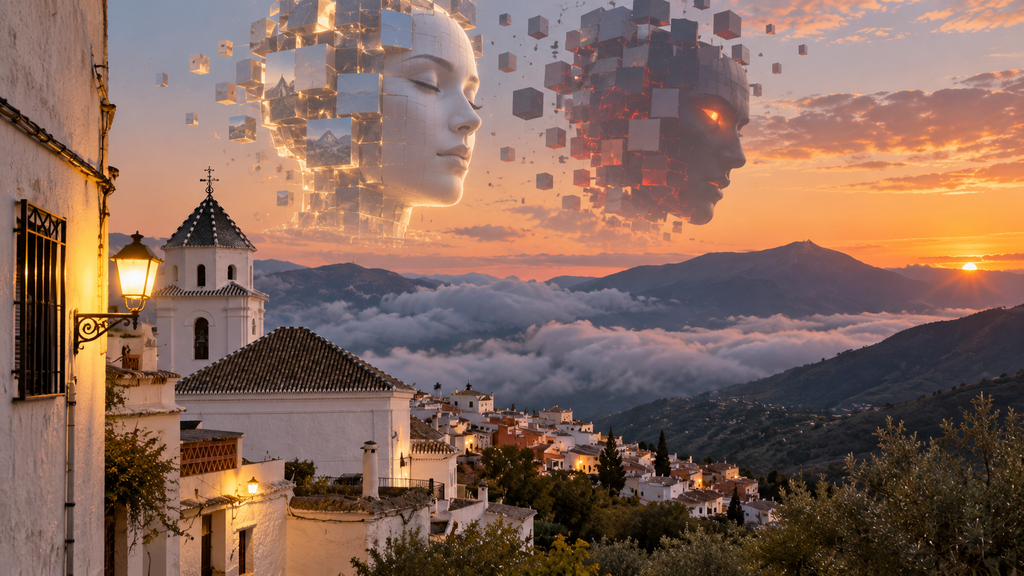
What about the infrastructure?
Many catastrophic AI “doom” scenarios depend on access to networked systems: banking, electricity, transport, communications, and logistics. Water has also been mentioned. These utilities all present serious vulnerabilities in digitised societies. However, the impact is less straightforward in a mountain region where cash remains commonplace, old diesel vehicles are everywhere, and daily life is based on ancient systems that existed long before the internet and AI were even a twinkle in someone’s eye.
Freeze bank accounts and there will be chaos – but some people have a small fortune hidden under the mattress. Disable electric vehicles and much of the local fleet will remain unaffected. Those elderly Berlingos, battered pickup trucks, and 20-year-old bangers have no app for charging.
Water is also difficult to control. The Alpujarra’s landscape is criss-crossed by ‘acequias‘, springs, fountains, and irrigation channels. Their history predates Silicon Valley by centuries – dating back to the Berbers, for example. Water is distributed according to arcane turns, customary rights, and local knowledge. Disputes over who opened an ‘acequia’ gate, and where the water was routed, don’t require computers.
AI superintelligence might eventually control global financial systems, and AI in La Alpujarra could bring down our banks, but it won’t know the burning answer to: “Who upstream on the mountain stole the water out of turn for their olive trees and goats?”
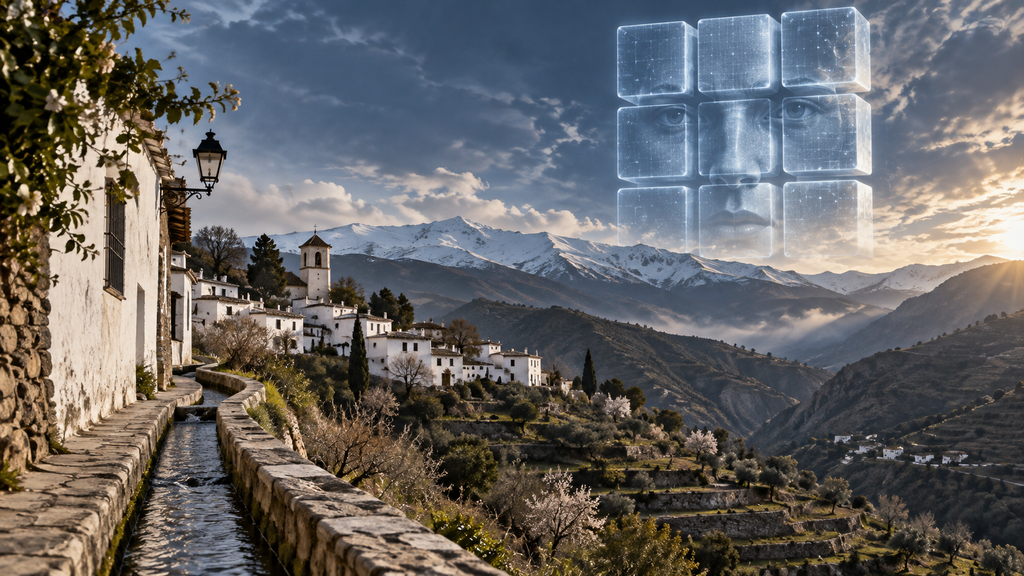
The paperwork problem
Spain has digitised large parts of public administration, while retaining a great attachment to paperwork (“red tape”). Anyone who has transferred ownership of a second-hand car, dealt with property transactions, argued about land boundaries, or applied to burn agricultural material knows about the onslaught of personal ID, application forms, taxes, declarations, and appointments. Largely based on paper.
Agricultural burning in Andalucía can require applications to be submitted to your town hall. Even if we have superintelligence, you probably need a paper permit to burn some twigs and weeds on your land.
Then we have the “digital divide”. Some older agricultural workers can repair machinery, irrigate land, handle livestock, and navigate unmade forestry tracks in an old banger. However, the same individuals might struggle with online forms or smartphone apps. They simply have a different relationship with technology.
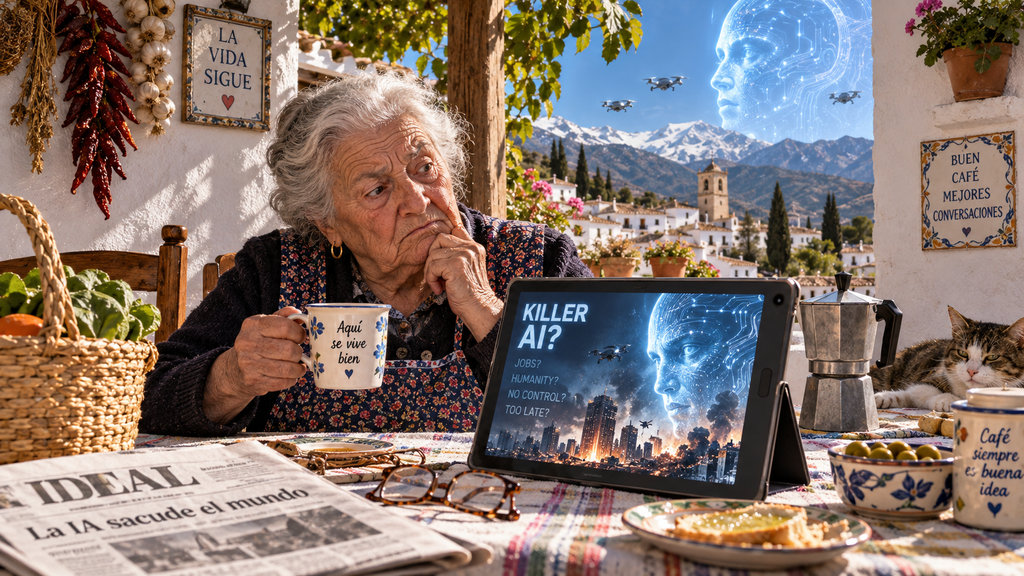
AI in La Alpujarra reaches fiesta posters first
Digital divide or not, AI has already seeped into life in La Alpujarra, including local publicity efforts. To use a bad metaphor, it’s like water from a leaky irrigation tube darkening the ground below. Village fiesta posters now look the same (rather like our example images above!). From Granada to Guadix, generative AI has aided the appearance of twee white villages, dramatic mountains (the Matterhorn?), flawless dancers, flagons of beer, and a “café style” that has no real relevance to the rural Alpujarra.
Cáñar is not Lanjarón, Lanjarón is not Órgiva, and Órgiva is not Bubión, yet synthetic content manages to flatten the area’s villages into the same depiction of forced communal fun. Some of it looks like Oktoberfest, not rural Spain. The same problem appears in video content, where many users have not caught up with AI’s increasing abilities. Some promotional material remains stuck in the era of slowly panning still images, synthetic narration, and music suggesting the imminent arrival of a medieval court jester. Just like the ‘Drowsy Historian’ on YouTube, before this type of slop faced a backlash (although it is still there).
A smaller argument surrounded the recent AI-generated 1980s image “challenge”. The environmental cost of data centres and generative AI is real, but memes about how much water it used are insupportable without stating a methodology and source. Any serious debate about water waste is weakened by unsubstantiated claims on social media.
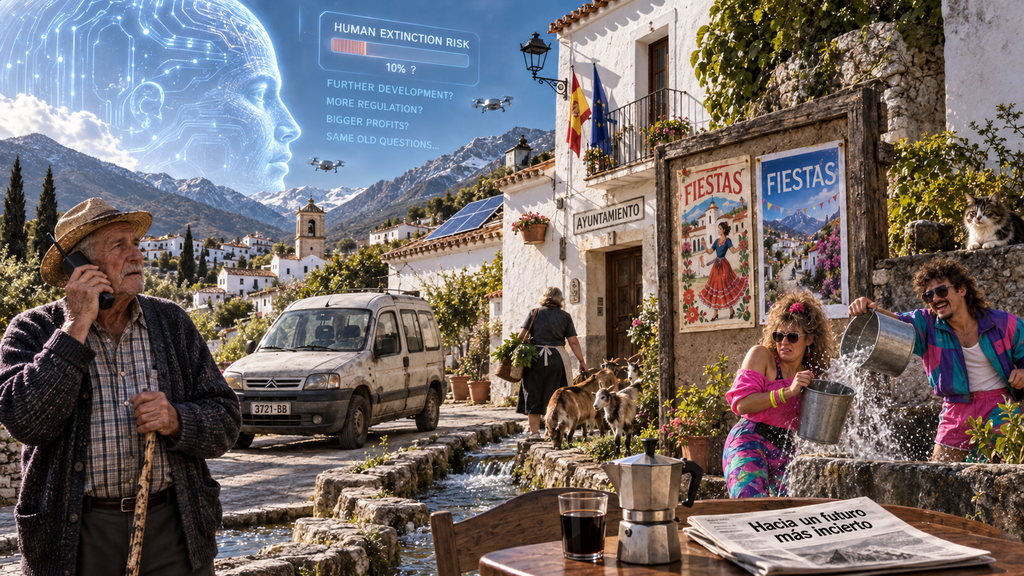
Apocalypse postponed?
None of this makes rural Granada immune to technological chaos. Electricity, telecommunications, banking, and digital public services matter everywhere in Spain (and internationally). However, many extinction scenarios play out with the assumption of communities being permanently connected to the “grid” (i.e. internet and network services), and heavily dependent on apps.
La Alpujarra is partly that society. And partly not. It has some rebellious tendencies. During Spain’s April 2025 blackout, some residents were circulating with their own generators, cash, solar energy and non-electric vehicles. Add that to vegetable plots, goats, chickens, springs, ‘acequias‘, and “the old ways”, maybe it is not quite ‘Apocalypse Now’ in rural Granada when the AI extinction event supposedly occurs.
Coxon may prove correct, and the machines might outpace their creators (not always difficult!) and start “taking over”. Even then, overthrowing the global financial system might prove easier than transferring ownership of a 2004 Citroën Berlingo in rural Alpujarra, or obtaining a ‘Libro de Explotación‘ for a horse.